Saturday, September 14, 2013

Last day in Wales

One of the readers of this blog came up to me at a "Don't Bomb Syria" protest and told me that she loves the woven fence. The photo I used before was a close-up, so here is one for her from further back - a little more perspective.

Woven fence

When I was leaving Paris I felt pretty satisfied that I'd seen it - not really all of it, of course - but enough. And I'd enjoyed it plenty! I was sad to think that I might never see it again, but I was okay with it. Not so for Scotland or Wales.

Sky over Bala Lake

I have to make it back. I can't imagine how, but I intend to try.

Colorful Bala

Our last day was a free day. We had to get an early start the next day, so there was packing of course. Some chose to head out to see the woolen mills (there had been promises of sweaters and such to loved ones back home), but I chose to stay back and wander around Bala. I'd seen these colorful house/apartment fronts from the car, but never walked on the street (how different from Paris).

For sale! Downtown Bala

Anyone care to invest in partially restored building? This photo is of the restored rear "town houses of character" but maybe we could create a little ex-pat community in downtown Bala. It has everything you need, though if you want to get much from the bookstore, you'll have to learn Welsh. 

"Grand Opportunity"

Some need more work than others. I like this window, so I might have to hire an architect and.....
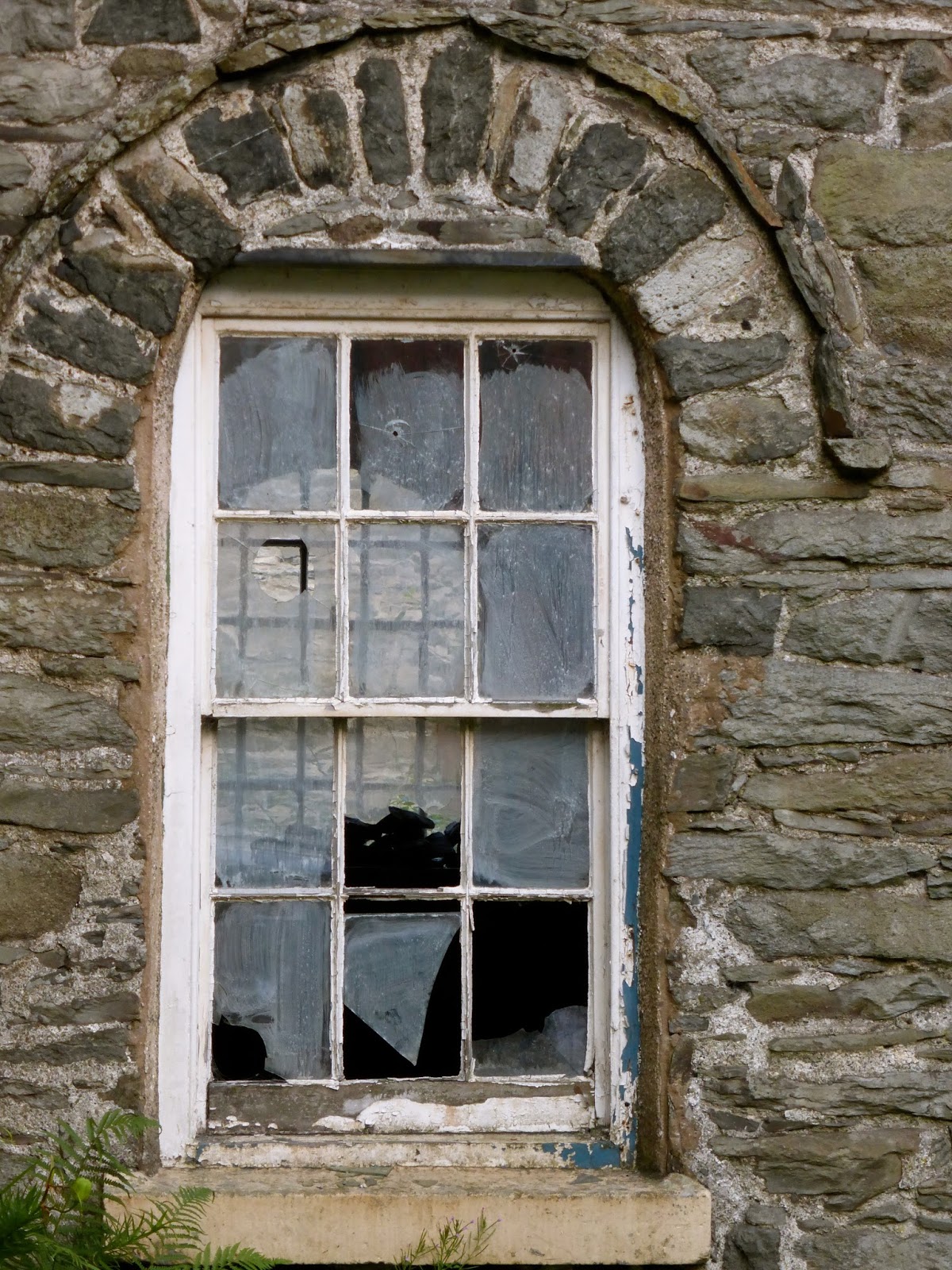
Window on the main drag of Bala

Of course, any stroll should include a visit to a local church and graveyard. There are a few in Bala and I only went to one.

I think this was Church of Wales/England

I continued to add to my collection of photos of grave ornamentation. Many of the gravestones were written in Welsh, as befits a town with one of the highest percentages of Welsh speakers. There was also a grave of someone who had worked for Queen Victoria - in English, of course.

The handshake means the two people buried below
will meet in heaven

Meanwhile, the group had returned from the woolen mill and Terry was wandering Bala scouting for a restaurant (we ended up at the White Lion that night) and she commented that of course she would have found me in a graveyard. There was a young man walking through (the graveyard had a path that was a well-trafficked shortcut) and Terry told him that she always finds me in cemeteries. He quickly put distance between himself and us.

Guinea hen(?) in the graveyard

That afternoon, Bala was filled with the bleating of sheep. I wandered around looking for the source and found them being loaded up in several very large trucks. I keep hoping that sights like this will turn me into a vegetarian.

Headed for my plate?

But this is one place where my practice does not match my values, I confess. I love meat and am obviously able to distance myself from the whole ugly business when I need to. 

Not vegan, either, obviously

Part of the day was spent at the White Lion, making sure I had all my remaining travel arrangements in order. The ferry line to Dublin had screwed up my reservation and we had quite a back-and-forth, but got it all worked out - one of the disadvantages of traveling without a phone.

Common roof ornamentation -
looks like the prow of a gondola

I actually loved being phoneless. Now that I'm home, I still often forget to carry my phone and rarely hear it when it rings and sometimes go all day without checking it. I like this arrangement, but others don't. Ongoing project of working out how much I owe to other people versus what I want for myself!

Half-brother to the queen's corgies

I spent some of the afternoon in the little bookstore where most books are in Welsh. It specializes in Welsh history, culture, nature, fiction, and children's books. But they had enough books in English to keep me busy. I bought Wales After 1536: A Guide because it had the most I'd seen on nonconformists in Wales (my ancestors). 

Duck family by the bridge

The same author has written a book on Radnorshire - where my ancestors lived. I'm in the process of tracking it down - it's in print. I always start with Copperfield's, but they can't get it. But the book did give me information which provided greater impact for what I saw in Chester (where I headed after Wales - next blog post).

The hills behind our house

I also wandered by the lake and, as is usual in Great Britain, you can wander through private property and sheep pastures (as long as you close the gates behind you). I am also reading Walking Home: A Poet's Journey about Simon Armitage's walk along the Pennine Way in England - though shorter, it's something like the Appalachian Trail and equally difficult and dangerous in stretches. 

Bala Lake and Cader Idris - the hounds
of the underworld fly around its peak 

I found out about the book through an interview of Armitage in the New York Times travel section. They asked him, "From Robert Byron to Rory Stewart, Britain has its fair share of walking memoirists. For you Britons, what is it about walking?" Armitage replied, "Part of it, I would argue, is political. In the '30s, there was an effort by regular working-class people to reclaim the common land as their own. It's what's known as the 'right to roam' movement, and behind it is a political notion that most of the land cannot belong to somebody else, it has to belong to the people. So the network of footpaths and open access to land in this country, I think, is pretty much unprecedented. And more practically, you really can walk to places in Britain. It's not like walking from New York to Cleveland. You can actually set off and get to places here." So, of course, I had to get the book.

Same view - more sky

My brother lived in northern California briefly when he was in his 20's and didn't like it and moved back east. But he continues to be dismayed by how little public land is available for walking in the east as compared to the west. But it still all depends upon public land. In Britain you can walk through the pastures of the rich! And the working class movement to reclaim the land was sometimes violent and bloody (clarification - the landowners were violent and the working class ended up bloody and in jail). This would drive the liberal rich here crazy. Remember when Barbra Streisand threw a fit because people could get near her wedding? Coastal access be damned! Side note - she has been silent on Obama's bombing plans, while she was quite vocal about Bush.

Goodbye to Pen y Bont

As it turned out, the ivy was right and I had a good time traveling Wales with a group - though I'd be happy to travel alone or with my cousins and sister (Gillian has said this is making her want to travel in Britain). My new, possibly unattainable goal!

Tiny metal owl tucked into a beam
in the ceiling of my bedroom

I can't remember if I mentioned the owl hunt - I think I did - but just in case, here's one of 236 we found in the house.

And here's where we wrote

Just as on the first morning we selected a Welsh plant (mine was ivy), on the morning of our last full day, we selected another plant. Not so good this time. Sounds hard. Blackthorn - as ominous as its name: Blackthorn is a winter tree. The sloe, its fruits, ripen and sweeten only after the nip of the frost. White flowers are seen even before the leaves in the spring. It is black barked with vicious thorns and grows in dense thickets. The wood is used in the cudgel shillelagh and Blasting Stick. Its thorns are used to pierce waxen images.* 

My room is the window, upper-right

Physical: Unexpected change, plans altered or ruined. No choice however unpleasant. Events take over forcing you down the unavoidable path. Take courage, issues must be faced, decisions are unavoidable. Mental: Your negative view, clinging to old ways and facing challenges with anger and stubbornness will only make it worse and hurt you more. Accept the changes and move on. Spiritual: Realize you and your life have changed radially, enter reborn. As I said, sounds hard.

The window to Terry's room

And Terry will be doing this again next year - it will be the celebration of the 100th birthday of Dylan Thomas. I highly recommend it. Now, on to Chester.

Don't know what this says -
it was over someone's door

* waxen image - an effigy in wax representing a person whom it is desired to injure by witchcraft; it was believed that the victim would waste away as the wax melted in the fire, and feel pain if the figure was pricked or pierced. - Oxford Dictionary of Phrase and Fable

More research finds that this is the most sinister tree of the Welsh trees. In cultures in Great Britain - Celtic and Christian - it is associated with war, blood, and death. It is also associates with witches (the bad kind!) and is used to harm and curse. Coming home, I must have caused Obama to start threatening with missiles - I'm sorry!

Traditionally, blackthorn is used to protest against evil (as well as cause it?), creating boundaries (this must be the not answering the phone tendency I have), purifying, confronting our own dark side. Blackthorn dispels negativity (as well as facilitates it?), toxins, old wounds, and impurities.

But the Welsh description I drew indicates that blackthorn will give me the strength to persevere in adversity. I'd really just like to forego the adversity, thanks.

Blackthorn is sometimes called the Mother of the Woods or the Dark Crone of the Woods.

Blackthorn

Tuesday, September 10, 2013

Catholic sites, oh dear!

Today, my friend, Dave, sent the following to me in response to my last post: "Dinas Bran an "iron-age fort?" Someone is being kind to strangers and/or sparing themselves the questions of the uninitiated. The wiki says that the Welsh translates as "city of crows." Well, yes, perhaps at some point that became the case. But I suspect an earlier translation would have been "power place of the god Raven," yet even that trips over the modern boundary that disconnects the spiritual from the ordinary. Places of power were not chosen haphazardly, but came from the priestly/poetic experience of a place (pardon the clumsy words, but hopefully you get my drift). I would imagine climbing to the top might put you in a very intense state indeed. No surprise, then, that the feudal lords of a later period, attempting to control a peasantry still spiritually connected - and smarting because of it - would want to build their castle there. (And, of course, it commands the countryside.)"

Fabulous photo by Jerry Meshulam
of some of our group writing at Dinas Bran

Indeed, Dave, we did have discussions about this in reference to many of the places we saw that had been Christianized to remove the "taint" of Druidry/bardic tradition and anything else incompatible with  the patriarchal church. The book I'm reading now (and mentioned earlier), Finding Merlin, is very much about this process - though the author makes some leaps regarding details that are difficult to prove. I think that everyone who climbed Dinas Bran was moved by being there, particularly Rebecca, who feels its power very deeply - she really did not want to come down! And the Finding Merlin book devotes a lot of time to studying the names of people and places and suggesting that translations are often misleading - warped by Christianity's need to eliminate the power of the traditions that preceded it. And, oh, I wish I'd been confident of the ability of my knees to take the walk down! Thank you, Dave, for helping me bring this forth on the blog. 

Crutches left behind at St. Winefride's Well

St. Winefride's Well is most likely one of those sites which held spiritual and healing importance before its current incarnation. Winefride lived and was gruesomely killed, then resurrected in the 7th century (the century of Merlin and King Arthur) - a time when the ancient ways and Christianity were often in bloody conflict for domination in what is now the British Isles. She was decapitated for wanting to become a nun and her head rolled downhill and the well sprang up where her head came to rest. It was reattached with the help of St. Beuno, her uncle. That's one version, anyway.

St. Winefride

The use of the water here for curative purposes began in the 12th century. People still come to the site for healing. Three things are said to be required for healing: repeating the request three times; believing; and God's belief that the healing is for the good of the person's soul. So, if you aren't healed, it's not proof that this doesn't work, but most likely, that God doesn't think it's good for you, since it's less likely you screwed up the first two instructions.

The bathing pool

As someone who was raised by a feminist, I was exposed quite early to the bloody and patriarchal history of the Catholic Church and freely admit that colors almost all my reactions to it. But I am interested in all of it from an historical perspective.

Graffiti from an earlier century

Though I got into my usual photo taking mode - what's beautiful, what's strange, what reflects something I don't see at home - I must admit that this place felt creepy to me. But obviously, taking photos of Catholic cathedrals doesn't bother me, so why should this?

Instructions

We had the option to write there and I knew that it would be difficult to write anything that was not angry - and I'd already written a few of those during the course of the workshop. But I did find a lot of subjects for my camera!

Being carried to the well

On the other hand, there were members of the group for whom this site was very important and they were moved to write. We heard some of this writing and it was quite powerful and affecting. I was quite glad that we went - for the simple experience I got out of it because I'd never been to a holy well - and for those for whom it had so much meaning.

Source

It's difficult to see in the photograph, but this is where the water is entering the pool - it's bubbling up.

Offerings

And I had a nice talk with the man in the gift shop (a true believer!), who is a member of the champion male voice choir. We had considered hearing a choir practice, but he said they take the month of August off. Again according to the guidebook, the choirs arose during the temperance movement of the mid-19th century (my great-grandmother ended up in the women's suffrage movement after attending temperance meetings at that time). 

The church at the well

They were very important in coal-mining towns and began to disappear with the decline of those communities. But they are back with a vengeance and there's actually a reality TV show about them. The man in the gift shop was a very proud performer.

Sinking graves

Dog at the well

Now for something much more mundane. I was sitting outside the gift shop near a young man and his dog. He was waiting for his mother. When she came out, she stopped to talk to me and tell me how wonderful my really ordinary corduroy shirt was. She exclaimed several times about what wonderful clothes Americans have and really urged her son to agree. The poor guy finally had to give in and agree that my shirt was quite extraordinary, much to his discomfort. I never did figure out what the big deal was - it wasn't so much better than what she was wearing. It did seem that she was quite delighted to find herself talking with an American.

St. Beuno's

Yep, same St. Beuno who reattached Winefride's head. During the course of the workshop, we read poetry by the Welsh Jesuit priest, Gerard Manley Hopkins. He wrote poetry when he was young, but when he converted to Catholicism, he burned most of his poems.

Bust of Hopkins

He went on to study at St. Beuno's, a Jesuit monastery that is now a retreat center. He had not written a poem in seven years when he was asked to write a poem about the wreck of a ship. We were given the opportunity to write in the room where he resumed his poetry writing.

Maureen led the writing group that day

I really love some of Hopkins' poems - his prosody experiments - sprung rhythms (you'll have to take a course from Terry to learn all about this!) that resulted from his ecstatic experiences in the beautiful Welsh countryside. 

Looking over us

Others completely frustrate me because they are so religious - I don't believe in god in any form and resent attributing this beauty to "him."

The window to the room where we wrote

Here's one of his more famous poems - about a falcon - and an excellent example of that ecstasy - interspersed with photos of details at St. Beuno's.

Boot scraper by the front door

The Windhover

Caught this morning morning's minion, king-
   dom of daylight's dauphin, dapple-dawn-drawn Falcon, in his riding
   Of the rolling level underneath him steady air, and striding
High there, how he rung upon the rein of a wimpling wing
In his ecstasy! then off, off forth on swing,
   As a skate's heel sweeps smooth on a bow-bend: the hurl and gliding
   Rebuffed the big wind. My heart in hiding
Stirred for a bird, - the achieve of, the mastery of the thing!

Egg cartons by the kitchen door

Brute beauty and valour and act, oh, air, pride, plume, here
   Buckle! AND the fire that breaks from thee then, a billion
Times told lovelier, more dangerous, O my chevalier!

Meerkats in the front hedge

   No wonder of it: sheer plod makes plough down sillion
Shine, and blue-bleak embers, ah my dear,
   Fall, gall themselves, and gash gold-vermillion.

Gnome in the garden

If you have trouble with the poem, just read it out loud. It makes all the difference - the feel of it in your mouth. I've used "wimpled" in a poem - inspired by this. Hopkins had trouble reconciling this very physical, ecstatic poetry with his existence as a Jesuit priest and most of his poetry was published after his death.

Butterflies everywhere

St. Beuno's had beautiful gardens and it was absolutely filled with butterflies and bees. They know what they're doing there!

Reflection of St. Beuno's in the lily pond

In the far distance were windmills out in Liverpool Bay (the windmills are a hot button issue I found out while talking with the peaceniks at the Eisteddfod), but my telephoto caught them looking very surreal.

Wind power

And it was Else's birthday, so we celebrated at dinner.

Else on her birthday

Rebecca, Terry, Jodi, and Jerry

Else, Jerry (blocking Phyllis), Maureen, me, Rebecca and Terry

And just to make sure you have (almost) everyone straight, here's a photo Jodi took of all of us (except her) lined up in the audience at the Eisteddfod.

Rebecca, Terry, me, Else, Phyllis and Jerry not paying attention, and Maureen

And we have only one full day left in Wales.

St. Beuno's library