

Conwy Castle
I'm reading Finding Merlin and I don't yet know what I believe, if I ever will, but it's fun reading the author's modern take on things - like trying to prove that the father of Merlin's greatest enemy was a homosexual (we're going back to the year 640 with nothing in writing from that period).

More Conwy
What it illustrates is the leaps you have to take and the assumptions you have to make when going back to reconstruct one's ancestry. Because so many details are missing, one of the goals for me was just to be in the places where they had been - with all the limits implicit in it's being 350 years later.

Looking up, as usual
So I was particularly on the lookout for things - buildings, etc. that were around in the 17th century.

Plas Mawr
We went to the Plas Mawr in Conwy, billed (depending upon where you look) as the oldest townhouse in Wales or the finest surviving Elizabethan townhouse - built in 1585. It gave me the ability to stand in a house like the ones my ancestors would have seen - probably would not have had the money to live in, but who knows.

Clothes which, I suppose, depend upon economic status
 Kitchen - did the Eatons have one or work in one?




We're certain about John and Joan Eaton, who left Radnorshire (the county) in 1686, 1687, or 1688 - my great-great-great-great-great-great-great-grandparents. Beyond that it's a little iffier - based more upon what's not said - but it seems John's father was also John and his father was George (1580-1641) and his mother was Ellen Hatfield and George was the first recorded person with the name Eaton (sometimes Eatton) in Wales.

Did they have ornamental pots
in Elizabethan Wales?
And true to form, little to nothing about the families of the wives - sometimes not even her first name. She was going to die in childbirth anyway, wasn't she?

Carved chest at Plas Mawr
Plas Mawr was additionally interesting because everything had carving - all the furniture, the walls, the ceilings. Some of it was beautiful and some quite strange.

Above the mantlepiece carvings/stamps

Little door within the big door
Conwy Castle is right in town, though you can't tell it from the previous pictures.

Conwy Castle seen from Plas Mawr
And every once in a while, there needs to be some proof that I was actually there - an advantage of traveling with others.

On the walls of Conwy Castle
We had a nice lunch at a restaurant, Amelie's, inspired by the movie supposedly, but the food wasn't French.

Terry and Jerry - probably commiserating
about being the drivers
(oncoming traffic in the middle of the road)
They had some very Welsh food and Welsh-sourced ingredients. I had Welsh sausages with a potato-leek mash. I really liked the leeks in the mashed potatoes and had that a few times subsequently, but Amelie's was the best. I haven't made it at home yet, but I intend to.

Hard cider from Ireland
I have since been informed on Facebook that Magners cider is for weenies - too sweet. I thought it was delicious and went well with the food, so I acknowledge being a weenie.

Window decoration

Cakes
We didn't have room or time for dessert, but they looked good.

Decorative details everywhere you look
It's fun to see how different the details decorations in Great Britain are from the ones in France. Great Britain has more simple architecture - which I like a lot having spent some of my youth around Georgian architecture in the U.S. northeast.

Maybe this? If I remember correctly,
the type style carved into the building was Art Nouveau
I didn't see much Art Nouveau or Art Deco in Great Britain, though more of it must exist given that Charles Rennie MacIntosh and William Morris were here. My trip through Great Britain wasn't urban enough, I guess. Later, in Chester, I would find that they recreated Elizabethan buildings during the 1880s.

Commando raid on Conwy or rescue?
We never found out.
There was a falconry exhibit right by the castle.

Love those eyes!
I remember driving through the Tule Lake reserve in NE California and spotting a great horned owl in a tree because its eyes were open and they just jumped out at me. If the eyes had been closed, I'd never have seen it.

He was keeping a sharp eye on us.
I really hate the idea of keeping these birds captive, but, like most people, I loved seeing them close up. They seemed pretty calm, resigned to domesticity.

View from the castle
Conwy is in the middle of a holiday area. The Victorians love seashores AND conveniences (yeah, so do I), so they built long promenades with rows of hotels and houses along the shore.

Gull encounter
We went out in search of the promenade at Llandudno, which can be seen from the castle, but we never found it, though we found a less fancy one.

I love these sparkles!
It had a big shallow pool used for model boats and lots of swans.

Llandudno
Welsh pronunciation lesson (I think) - "Ll" pronounced like a wet hard "chl" like the "ch" in "ach" in German with an "l" on the end - lots of these in Welsh and the "u" is like a short "i" (I think). Rebecca kept teaching us, but I'm not sure how accurately I learned.

Multiple varieties of gulls
The next day we headed out to the south coast of Wales, where Dylan Thomas lived and wrote. Pretty much anywhere you drive in Wales is a beautiful drive (if you're not having to keep your eyes on the road and drive on the "wrong" side and figure out how to make it between the big truck and the stone wall).

Radnorshire - home county of the Eatons
I imagine that Radnorshire looks much as it did in the 1600s since the cutting down of the forests took place long before, though the enclosures (fencing and private property) hadn't been fully established.

Sheep and rain on the lens
Radnorshire was the center of Nonconformism in Wales (though the first chapel was erected in the south). Nonconformism meant refusal to be Church of Wales and usually meant being Quaker, Baptist, or less so of several other "protestant" faiths. This arose in the 17th century during the turmoil of civil war, beheading of Charles I, ascendancy of Oliver Cromwell, return of the monarchy and had real roots in the overturning of the religious order by Henry VIII.

Church in Llanddewi
We stopped in two of the four places I wanted to see that are mentioned in family history (two were in the wrong direction). I am very grateful to my fellow travelers for being willing to stop. They ended up finding the places interesting and enjoyable, but there was no guarantee of that, so I thank them.

Lunch in the rain sheltered by the church door
We saw churches in both places, but they are Church of Wales (essentially Church of England). Because the nonconformist faiths were outlawed until 1689 (Catholicism and Unitarianism continued to be illegal), they did not have churches (after 1689 they erected chapels - much simpler structures). They would meet in private homes. And they could not be buried in consecrated ground.

Old farm building in Llanddewi
Therefore, they left few records and ancestry is more difficult to track. We know about John and Joan Eaton principally because they left, helped found a church, and were buried in a Welsh/American cemetery. Llanddewi is where they were baptized - done in a river and after you were 16. I had thought it was where they had been married, but that was one of the towns we couldn't visit.

Church in Nantmel
Nantmel is also mentioned in relation to the Eaton's, as is the nearby Dolau Chapel, but they could not have gone to the chapel because it wasn't built until after they left. Nantmel has had a church on this spot since the 5th century and the parish has erected a big historical sign which pays some attention to the nonconformists.

Nantmel - part of my collection
of gravestone ornamentation
While the Eatons were in Wales, it was illegal for more than four people to attend a religious meeting (as opposed to attending a legal church). William Penn left Wales in 1682 and founded his religious community in what would end up being Pennsylvania and many of the Baptists followed him. One source says he left to escape religious persecution and another says the king gave him a big tract of land. Don't you love history?

Terry at the aqueduct in Nantmel
Between 1650 and the passage of the Toleration Act in 1689, 14,000 nonconformists (mostly Quakers) were imprisoned and 369 died there. The story goes that persecution made them stronger. John and Joan went to Philadelphia (dates in question - she may have followed him later) and helped found the Pennepack Baptist Church in 1688, which celebrated its 325th anniversary this year. They formed a union with three other Baptist churches and were buried at one in Delaware.

Sign in the window where we parked in Llanddewi
I found a book in the little bookstore in Bala - Wales After 1536, A Guide by Donald Gregory - and it had more about nonconformists than I had found elsewhere. He also wrote a book on Radnorshire. Copperfields says they can't get it for me, but the Bala store said they would. I'm not quite sure why this is so fascinating. What real connection do I have to people who lived 350 years ago? Would I be as interested if they were not rebels? I AM in awe of people who headed out in dangerous boats across the ocean. How much of their spirit could be in me? I do know I love finding the "political" story of their lives. I'm more interested in the Scots ancestors now that I think the Clearances may be part of their story. For whatever reason, I do intend to delve into this further - if only to flesh out the time periods for myself - when I have time.
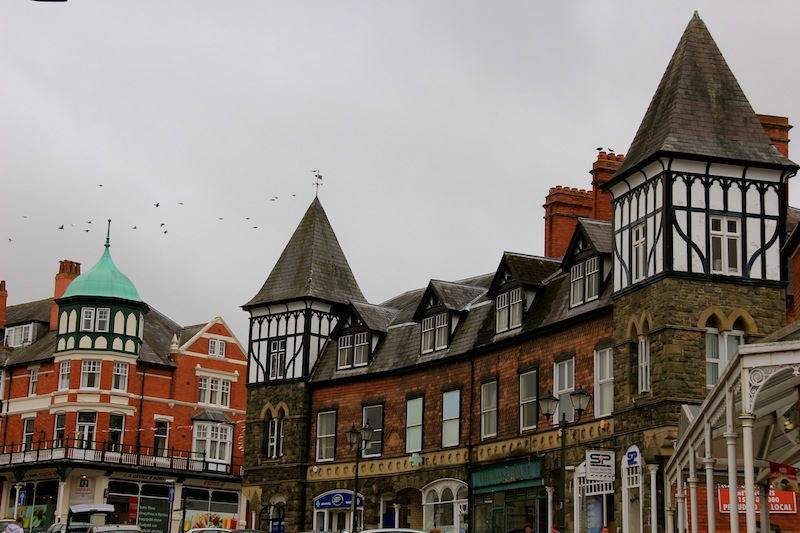
Llandrindod Wells
Llanddewi and Nantmel were so small - only a few building each - so we stopped at Llandrindod Wells (if only for the public bathroom) - once a Victorian spa town (complete with fake Elizabethan architecture) that has seen better days.

Bookstore and sentiment at Hay-on-Wye
Our last stop before getting to Laugharne, our destination, was the town of Hay-on-Wye, which is known for its used and antiquarian bookstores - 26 of them. We didn't get to see many of them because we arrived late - most stores in Wales close at 5:00 and some of them close up early. We were actually happy to see the priority put on going home at the end of the day. There was no American emphasis on only getting ahead if you work extra hours!

Shop dog, Dante, at The Poetry Bookshop
We did make it to The Poetry Bookshop - the only bookstore devoted solely to poetry in Great Britain. I bought my Robert Burns poetry book here. Everyone bought something and we had a delightful conversation with owner, who finally had to remind us that he needed to go home. We couldn't argue with that!

The store that started it all
The whole thing was started by one guy, Richard Booth, in the 60s - characterized as charismatic and a maverick. He was definitely a master marketer, who became rich and famous. He proclaimed himself King of Hay and engaged in many publicity stunts and put Hay-on-Wye on the map.

More than books in Hay-on-Wye
We made it to Laugharne - Dylan Thomas' home base - later than we'd planned (blame the ancestral stops). Thomas' home was called the Boat House and we stayed at a B&B named The Boat House - simple from the outside and very 'luxe inside.

The Boat House B&B
We only had one choice for dinner (this is NOT Paris - everything closes early) and, though the food was good, the owners were crazy. Everything was made to order (of course, that's not crazy) and it took forever to get our food - longer than it should have - I don't know what they do when the place is full. Some of our group were really drooping from hunger and fatigue.

Dylan Thomas staring out in front of our B&B
The wife was quite a high-pressure saleswoman and we ended up with more than we needed in quantity, but what we needed to survive until our main courses arrived. They made a mistake in the order - no main course for someone (Terry?). They then told us to take food off other's plates, since no one had touched them yet! When they did finally show up with the dish, everyone else had finished (risotto cooked to order does take a long time).

Brown's Hotel - Thomas' favorite pub
and our wifi spot
By then, Jody had collapsed and gone back to the B&B. They said that they'd pack up her dinner and, since we didn't have refrigeration, we could just place it on the windowsill! When we said no to that and asked if they could store it their refrigerator til the next day, they wouldn't give it to us and said Jody should come back the next day and they'd cook it again for her. Too bad - the food was good - but we had no intention of going back there again.

Inspiration for Dylan Thomas


